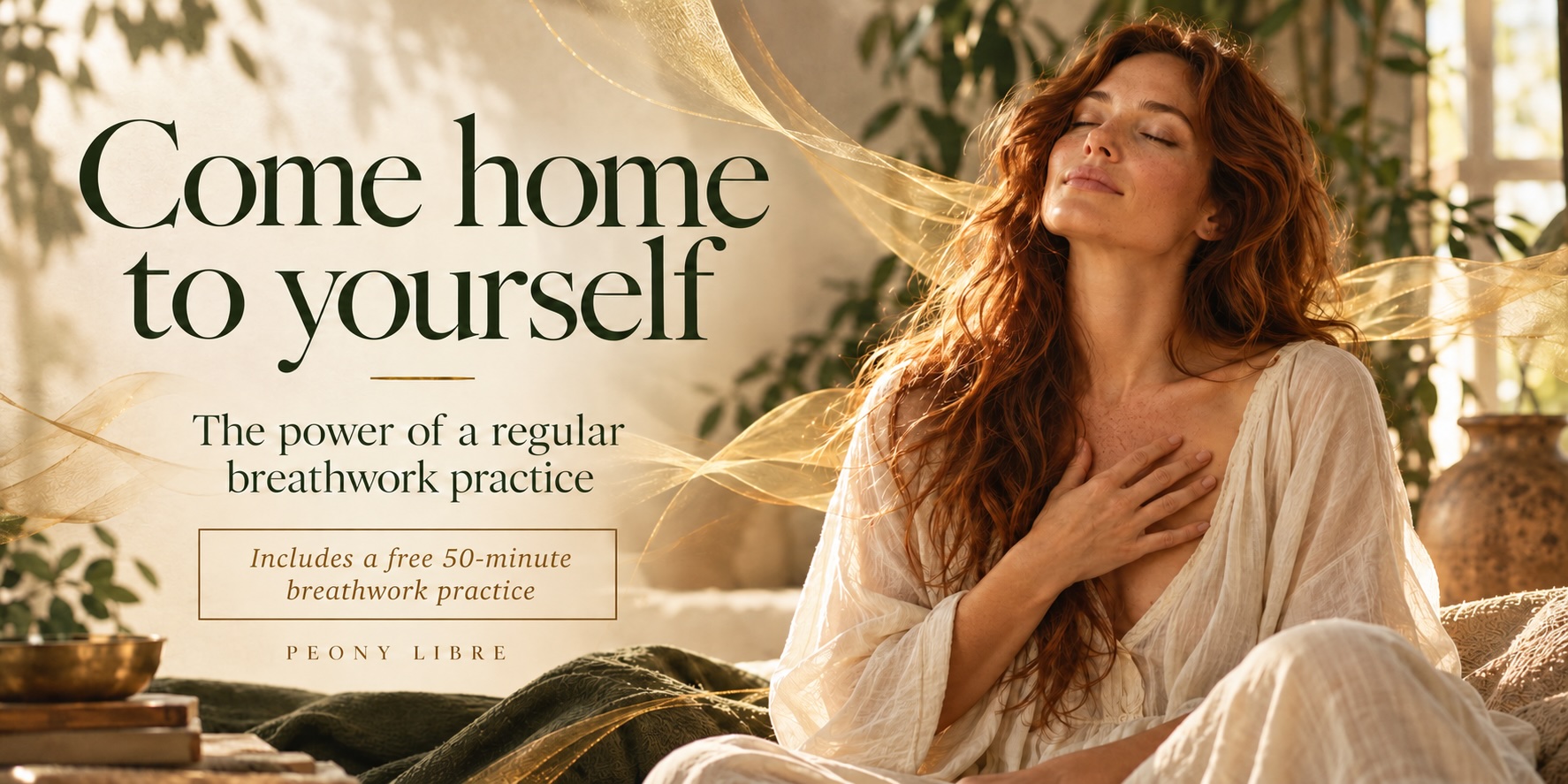
For years, I struggled to stay present in my own body.
I could be in a room, having a conversation, doing everything I was supposed to do, and still feel disconnected from myself. Slowing down meant feeling things I had spent years trying to avoid.
After trauma throughout my childhood, teenage years and early adult life, being in my body did not feel safe.
So I kept moving.
I spent my twenties drinking, going out, distracting myself. Doing everything else but feeling what was happening inside me.
Then, in my thirties, life made me stop.
I had to look at why things kept happening the way they did. Why I kept reacting. Why understanding my patterns was not enough to change how I felt.
Breathwork became a huge part of that work.
It helped me learn how to be with myself. How to meet what I was feeling. How to move through an experience instead of reaching for the next distraction.
And it helped me open to something I had been disconnected from for a long time.
Pleasure. Desire. Presence. Feeling alive.
This is why I still practise breathwork. Why I teach it. Why, when someone tells me they are ready to move forward in their life, it is one of the first tools I invite them to explore.
There is more to breathwork than calming down
When people hear “breathwork”, they often imagine sitting quietly and taking a few slow breaths.
That is one part of a much bigger practice.
In my classes, we work with different breathing techniques and different intentions. We use energising breath. Clearing breath. Practices that wake you up and bring your attention into your body. Practices that help you settle and integrate afterwards.
Some techniques are stimulating: your pulse can rise, and the experience feels active. Others bring you towards stillness.
We work with that range.
Because sometimes you need rest. Sometimes you need to feel the energy you have been holding back. Sometimes you need to stop thinking about making a change and give yourself space to engage with what is happening inside you.
My intention is transformation.
I want the work to reach beyond the class: into how you meet yourself, what you allow yourself to feel, and the choices you make afterwards.
Breathwork helped me open to pleasure and desire
When I talk about feeling pleasure, feeling sexy, feeling desire, feeling turned on by life itself, everyone has a different understanding of those words.
You might say, “I already feel that.”
And I believe you.
I am talking about a layer I discovered through my own practice. A depth of connection that I did not know was available to me before I experienced it.
For me, there is something deeply spiritual about this.
Being present enough to let life reach you. Feeling your own energy. Recognising what you want. Allowing yourself to enjoy being here.
Pleasure became something I could receive.
Desire became something I could admit to myself.
Feeling sexy became something I could feel in my own skin, for myself.
When I had spent so long numbing out, opening to that was profound.
Breathwork was a huge part of it, alongside the other work I was doing. It gave me a practice I could return to as I learned to stay present with more of myself.
I am sharing this because “feeling calmer” does not describe the full meaning breathwork has had in my life.
It helped me feel alive.
Safety is the foundation for going forward
When I say breathwork helped teach my body that I was safe, I am talking about learning to stay with myself.
To feel something and remain present. To recognise when I needed support. To know that I had a choice in how I responded.
That became a foundation for movement.
Because I wanted more than coping. I wanted to be able to want things, express myself, be seen and take the next step.
In the space I hold, there is room for energy, emotion and expression. There is also room to pause, adapt and listen.
You do not have to override yourself to prove that you are ready.
You get to participate. To explore your capacity. To discover what happens when you give yourself both support and permission to move.
Your breath gives you something practical to work with
Notice what happens to your breathing when you are stressed.
You hold it. It becomes shallow or quick. You brace before you have even realised what is happening.
Your breathing and your nervous system influence each other. Working consciously with the breath gives you a practical way to engage with your state.
Different techniques have different effects. Some are stimulating. Others support settling. Learning that difference matters.
You start recognising what you need and which practice to use.
That is part of the value of learning breathwork: you leave with tools you understand through experience.
Why I offer breathwork alongside sound baths and workshops
I love sound baths. In my spiritual practice, they are a space to clear energy, receive and let yourself be held by sound.
Breathwork brings another form of participation.
You work with your own breath. You learn the techniques. You feel the difference between practices. You develop an understanding of what supports you.
And appropriate techniques can come with you into everyday life.
Before a difficult conversation. After an overwhelming day. When you notice yourself bracing. When you need to reconnect before taking action.
This is why breathwork remains such an important part of what I offer.
The class gives you an experience. The learning gives you something to keep working with.
Regular practice builds on what you learn
I did not practise once and suddenly change my whole life.
I kept coming back.
Session after session, I learned more about myself. About what I was avoiding. About what helped me stay present. About what I needed to move forward.
That is how I think about regular practice: each session adds to your experience.
You learn the rhythms. You recognise the techniques. You become more familiar with finding your way into the practice.
Progress has different shapes. An emotional session, an energising session and a quiet session can each teach you something.
Give the work a place in your life.
If once a week is a commitment you can keep, start there. Use the suitable tools you learn between sessions, too.
Consistency gives you something to build on.
The two types of breathwork I offer
Pranayama: energising, clearing and working consciously with your breath
Pranayama is the approach I use in my breathwork classes.
It comes from the yogic tradition, where prana is understood as life force. Different techniques work with breathing rhythm, sound, the nostrils and, in some practices, breath retention.
There is a whole range within it.
We can work with energising practices that feel active and awakening. We can work with practices I use for clearing and reconnecting. We can work with techniques that bring focus, balance and stillness.
The intention and technique matter.
For me, pranayama is a powerful way to explore your breath, your energy and your relationship with yourself—and learn tools you can return to.
Conscious connected breathwork: a deeper guided journey into feeling
Conscious connected breathwork links the inhale and exhale without a deliberate pause between them.
In my work, this is a guided journey into the body, feeling and expression.
It can be intense. It can bring emotion into awareness. It asks for presence and a willingness to meet your experience.
Some of my own sessions have felt like a profound reset: a shift in how I felt, a sense of release, a different way of meeting myself afterwards.
That is why this work matters to me.
I hold space and guide the journey, with time afterwards to settle and integrate what has happened. The practice is adapted to the person; intensity alone is not the measure of transformation.
What matters is what you take from the experience into your life.
Try my free 50-minute breathwork practice
I have included a free 50-minute breathwork practice from my YouTube channel below.
Give yourself the time to experience it.
Put your phone aside. Find a comfortable space. Follow the introduction and the guidance, and give the practice your attention.
Notice how you arrive. Notice how you feel afterwards. Notice which parts connect with you.
Free 50-minute guided breathwork practice with Peony Libre.
Practise seated or lying down in a safe place, away from water and never while driving. You can pause or return to natural breathing at any point.
Before fast or forceful breathing, extended breath holds or intense connected breathwork, seek individual medical advice if you are pregnant or have a heart or lung condition, a seizure condition or a history of fainting.
Allow yourself time afterwards to settle before moving into the next part of your day.
Continue with me inside my Inner Fire Camp – private membership
My regular pranayama breathwork classes are now part of the Inner Fire membership.
If you are ready to make space for this work, send me a message. I will share the details and explain how the classes work.
I teach breathwork because I know what it has meant in my own life.
From numbing out to being present. From feeling disconnected to recognising what I want. From struggling to stay in my body to experiencing pleasure, desire and aliveness within it.
That is the heart of the work I bring.
Start with the free practice. Give it your attention. And if you are ready to continue, message me about Inner Fire.
With love,
Kat
Peony Libre
Comments are closed